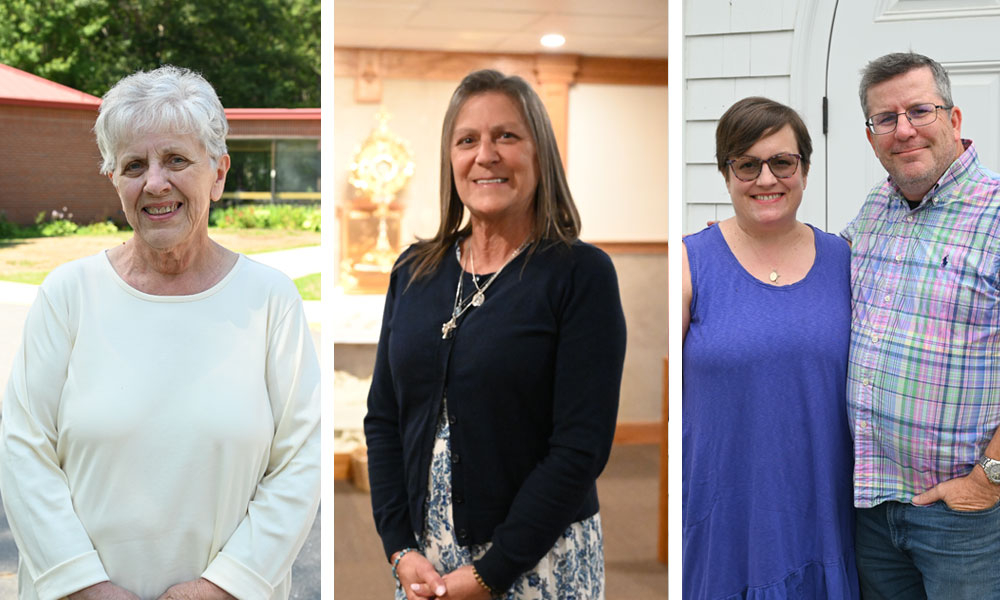
Coming home to the Catholic Church
“I wish I had a better-looking book.”
With its tattered cover, Una Connors’ beloved Bible is showing signs of wear, something that is not surprising because she turns to it regularly.
“I love it,” she says. “I do the readings every day.”
It wasn’t always that way for Una. Raised in a conservative Baptist household, she converted to Catholicism after getting married in 1964 to a man who was Catholic. She says she wanted to raise her family in the Church but was also drawn to the faith by childhood memories.
“I didn’t know anything about the Catholic Church, but there were all kinds of beautiful Catholic churches in Bangor, and there still are, and I was kind of fascinated with it,” Una says.
Una, who had moved to Brunswick, attended St. Charles Borromeo Church and brought up her two daughters in the faith, but the failure of her marriage after 17 years led her to walk away from the Church.
“I quit going to church. I quit all that. I sinned a lot,” she says. “I just gave up religion and gave up that whole thing because I guess I would say that I was mad as a hatter.”
It would take two decades for Una to find her way back. She points to a time in her life when she needed help and to the guidance she found in that well-worn Bible.
“I still can’t believe it because it was so right on,” she says.
The challenge Una was facing was caring for her mother who had dementia. Una says she had a difficult childhood because her mother battled mental health issues, and becoming her caregiver was something she didn’t feel prepared to take on, so she turned to God for direction.
“I was trying to say, ‘No, no, no. I can’t,’ so I decided that I would consult God,” she says. “I still believed in God, so I said, ‘You’ve got to show me which way to go.’ That’s why I brought out my old torn-up Bible.”
When she opened it, she says she couldn’t believe the passage in front of her. From Isaiah, it reads in part: “Release those bound unjustly, untying the thongs of the yoke, setting free the oppressed, breaking every yoke, sharing your bread with the hungry, sheltering the oppressed and the homeless, clothing the naked when you see them, and never turning your back on your own.”
“It makes me emotional,” she says. “Bang. There it was.”
Knowing she would need God’s help during the challenges that lay ahead, she returned to Mass. It was on Mother’s Day 20 years ago, with her two daughters at her side.
“I knew in my heart of hearts that I couldn’t take care of my mother alone, without help. So, when we sat in the pews, my daughters on each side, I felt like I was on cloud nine. I don’t think my body sat on that pew at all. I was so happy to be back,” she says.
Una says when she returned, the greeting she received from Marcy Brenner, who served in hospitality at the church, immediately made her feel welcome.
“When I came in the entrance, Marcy Brenner greeted me. She said, ‘Una! That’s you and your daughters,’ because she hadn’t seen them since they were little. She recognized me right away,” says Una. “What a greeting that was!”
As she cared for her mother, Una says God was by her side.
“Every time I seemed to get stuck on something that I wasn’t sure about, I consulted God, well, Jesus, our Redeemer. He was right there, willing to help me with whatever I asked for,” she says.
Her mother has since passed away, but Una’s faith is stronger than ever.
“I like to immerse myself, like someone going into deep water,” she says. “It was a totally different experience for me because I was being a Catholic because of my husband, but now, I’m being a Catholic for me.”
To others who have lost their connection to the Church, she says, “Don’t be afraid to come back. Don’t be afraid of that first confession,” adding, “You’re always welcome to come back.”
“I never lost that feeling that God was gently calling me home.” —Lisa Duchette
It is that message of welcome that the Diocese of Portland is hoping to communicate to others who have been away from the Church, whether it has been a few years or a few decades. Beginning in Advent, the diocese will partner with Catholics Come Home, Inc., an independent Catholic apostolate dedicated to inviting and inspiring inactive Catholics to return home.
“This gives us a chance to look at how we welcome people. How easy do we make it for someone to integrate into our communities? It’s an opportunity, I think, for all of us to look at ourselves and find how we are living the mission of the Church,” says Bishop James Ruggieri. “We are called to proclaim the Gospel. We’re called to create places or communities of encounter where people can encounter Jesus Christ and build the kingdom of God.”
“If you care enough about a soul, and you really care, you’re going to show them the love to invite them back to Jesus and the Church and help them on their journey to heaven. It’s the number one mission of the Church, so why are we not doing it?” says Tom Peterson, founder of Catholics Come Home.
Recent surveys reveal how critical that mission has become. According to a Pew Research Religious Landscape Survey, the number of adults in Maine who attend religious services at least once a month fell from 34% in 2007 to just 16% by 2023-2024. And during that time, the number of adults in Maine identifying as Catholic fell from 29% to 14%.
Peterson says work to reverse those trends begins with prayer. He recalls an early evangelization project at his Arizona parish during which parishioners went two-by-two to homes, offering to pray for people.
“I think one of the greatest ways to evangelize is just to ask people, ‘How can I pray for you?’” he says. “There wasn’t a fallen-away Catholic who didn’t need a prayer. Somebody has somebody in their family who’s sick, unemployed, dying, whatever. What a way to show Christ’s love — not by pushing anything on them but by giving them a free prayer. And anybody, no matter what their background was, appreciated the free prayer.”
Building on the foundation of prayer, Catholics Come Home has developed content to share the beauty of the Catholic faith on television, online streaming platforms, and social media. It also works with priests, parish staff, and parishioners to help them become more effective evangelizers and to ensure that parishes are places of welcome.
“Part of our campaign is to prepare all of our parishes to be welcoming places, to receive people who come back or people who are inquiring for the first time,” says Bishop Ruggieri. “It really should be part of our everyday reality anyway, but sometimes you get bogged down in the day-to-day, and some of those hospitality things, while not necessarily forgotten, can be perhaps overlooked.”
“It’s that welcoming spirit that really makes a difference. If you treat people like a business, it actually is bad business. If you treat them like a commodity, you’re not going to get any fruit. When you treat them with love, that’s Christ working through you,” says Peterson.
Like Una, Amy and Ryan Brown of Hope and Lisa Duchette of Lewiston can attest to the difference a warm welcome can make.
Ryan points to the reception he received from Father Anthanasius Wirsiy, pastor of St. Brendan the Navigator Parish in Camden, when he went to confession for the first time in years.
“He’s like, ‘Welcome back!’” says Ryan. “It wasn’t, ‘Oh, you should have been here.’ He’s like, ‘Thank you. You’re back.’ It was like when you haven’t seen your friend for years, and you come back and right away you’re comfortable. That’s how I felt.”
“Jesus is waiting for you. He wants to be friends with you. He wants to help you and to guide you.” —Amy Brown
Lisa says when she found her way back to the Catholic Church, she found forgiveness and she found a true friend in her sponsor.
“She listened without judgment, encouraged me when I doubted myself, and reminded me of something I had almost forgotten: the Church is not a reward for the perfect. It is a home for sinners seeking God’s mercy,” she says.
Born to a teenage mother, Lisa says she didn’t know that she had been baptized in the Catholic Church when she was a baby. Instead, she was raised in her father’s Episcopal faith, although she stopped attending services by her teen years.
“For decades, Catholicism was simply part of my history rather than an active part of my life,” she says.
Lisa says she only learned of her baptism after seeing a photo of herself in a baptismal gown, and that was when her life began to change.
“Once I learned the truth, something stirred deep within me. I began attending Mass from time to time, drawn by a quiet but persistent sense that the Catholic Church was where I belonged. Even though I wasn’t yet ready to return, I never lost that feeling that God was gently calling me home,” she says.
She says she was hesitant because some difficult turns in her life left her with feelings of guilt and unworthiness.
“I often believed I had wandered too far from God to ever find my way back,” she says.
But then, God put Lisa Daigle, who served at Prince of Peace Parish, into her life. The two connected through Lisa’s sister, who is related to Daigle through marriage. Lisa says that the woman who would become a trusted friend proactively approached her and then continued to reach out from time to time.
“My greatest obstacle was not whether the Church would accept me — it was whether I could believe that God still wanted me,” Lisa says. “My failures seemed louder than God’s promises, but through prayer, learning, and reflection, I came to understand a truth that had been waiting for me all along. None of us earns God’s love by having a flawless past. We come to Him because we need His mercy.”
Lisa says returning to the Church has changed the way she views the mistakes she made.
“They no longer define my identity. Instead, they remind me how deeply I need God’s grace and how limitless His mercy truly is,” she says.
Lisa participated in the Order of Christian Initiation of Adults (OCIA) and received the sacraments of confirmation and first Communion at Easter.
“There’s still so much to learn and to embrace. I’m still taking it all in,” she says.
She describes being part of Prince of Peace Parish as amazing.
“I just feel so welcomed,” she says. “Every time I put myself out there, I feel welcomed in: the things I volunteer for, adoration. There’s a Franciscan community here, and they are wonderful people. And our priests are amazing.”
She says she now tries to live her life in the way Jesus would want her to.
“I want to be good to people, good to myself, and obey His commandments,” she says. “There is a joy in my life that I’ve traded for all those sorrows.”
Amy and Ryan Brown say they, too, found a greater sense of peace after coming back to the Church.
“It’s comforting. It’s like a home. You’re welcomed and it’s nice, and it’s made me calmer about things,” says Ryan. “I haven’t been as anxious or angry about things.”
Although both were raised Catholic and they were married in the Church, Ryan and Amy say they didn’t regularly attend Mass, usually going only at Christmas and Easter.
“When we lived in Colorado, it was like keeping up with the Joneses. You had to work, work, work, and then everyone went to the park or whatever festival on the weekend. Everyone was doing the same thing,” says Ryan.
According to Catholics Come Home research, their story is a familiar one. Most of those who are no longer engaged in their faith say it is because they fell out of practice or became disconnected from the Church, not because they are angry with it.
After moving to Maine in 2018, Amy says she began to think about becoming more involved in the Church. Then, one year at Christmastime, she felt particularly drawn to going to Mass.
“It was like someone talking to you. Now I know it’s the Holy Spirit, but I felt like I needed to go back to church, like something was missing from my life,” she says.
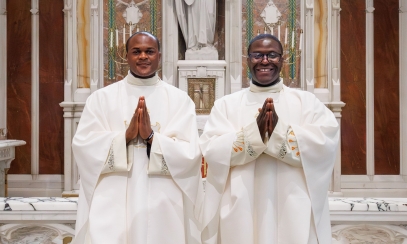
Amy says when they went to Mass, she was struck by the words and presence of Father Joseph Jum, then-parochial vicar of the parish.
“The priests from Cameroon are wonderful, and I think they have played a big part in our return because of … the word that is coming to mind is ‘intensity’ or ‘passion’ for the Lord and for the beauty of our faith. It was like a switch was turned for me,” says Amy.
Amy says she believes the Holy Spirit was urging her to return to Mass at that time because of a message they needed to hear. Father Jum spoke about caring for your parents, and a short time later, they learned Ryan’s mother had terminal cancer. They knew Ryan needed to leave to be with her.
“That was like the Holy Spirit saying, ‘Amy, you need to get to Mass. You need to hear that message and put it into practice,’” she says. “Imagine if we didn’t hear that call to go to Mass. We wouldn’t have that guidance. We wouldn’t have that support, and maybe things would be very different.”
The couple has rarely missed a Mass since, and when they do, they watch it on television. Amy, who is a fourth-grade teacher, also teaches religious education. She has made adoration part of her monthly routine, and she prays nightly using the Hallow app.
“I’ve just really been embracing our faith for its beauty and the traditions, which have been comforting to me, too,” she says.
The couple had their daughter, now a ninth grader, baptized, wanting to be sure that she knows the Church is there for her. It’s a message they hope others who have been away from the faith will realize as well.
“We want to see everyone at church. We want them to be happy,” says Ryan. “It’s not about who you are, where you’re from, what you’re doing, what you did. Just come in and be comfortable. And if you need help with something, everyone there wants to help you.”
“Jesus is waiting for you,” says Amy. “He wants to be friends with you. He wants to help you and to guide you."
Support the campaign
If you would like to financially support the diocese’s Catholics Come Home campaign, visit portlanddiocese.org/supportcch.