
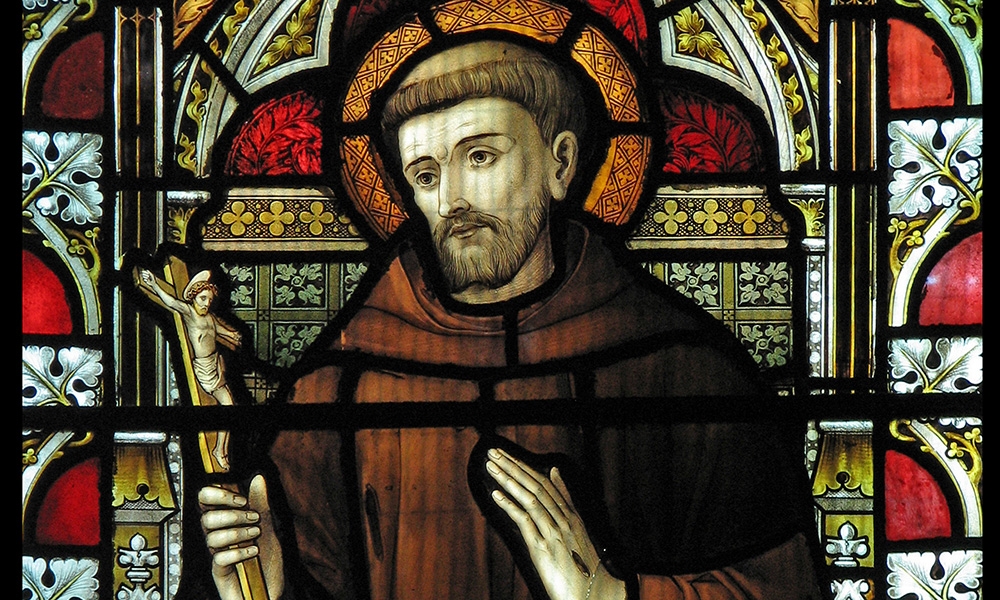
Jubilee Year of St. Francis
Eight hundred years ago, St. Francis of Assisi died on the evening of October 3, 1226. In his final moments, he asked his brothers to remove his clothing and to place him on the bare ground near the Portiuncula. This act was his final commitment to Lady Poverty, allowing him to die with absolutely nothing, as Christ Himself did on the Cross. Il Poverello (“The Little Poor Man” as he was affectionately called) left this world as he had tried to live in it: poor, humble, and entirely dependent upon the mercy of God.
Francis had spent his life stripping away everything that might compete with Christ. He embraced radical poverty not because he despised material things but because it brought him freedom. By owning nothing, he could belong entirely to the Lord. It made perfect sense that he would relinquish even the clothes on his back as he prepared to meet Sister Death. This was his spirituality…this was the new man that Giovanni di Pietro di Bernardone had become in Christ.
Francis of Assisi may have been radical in his embrace of poverty, but he was no renegade. He was a man of the Church through and through, and he lived completely within her heart, subjecting his whole life to her needs. He bound himself and his brothers not only to radical poverty but to radical obedience. He rebuilt crumbling chapels with his hands, but his deeper labor was the renewal of ecclesial life through daily fidelity and sacrificial love. Francis loved the Church because he loved Christ, and he knew that one could not be separated from the other.
For this reason, Francis does not belong merely to the pages of history; he belongs to the living tradition of the Church. Eight centuries later, the Church pauses to mark the anniversary of his death because his life continues to inspire and instruct us. To that end, Pope Leo XIV has invited the Church to observe the period from January 10, 2026, to January 10, 2027, as the Year of St. Francis – a time of renewal and deeper love for Christ and His Church.
Here in the Diocese of Portland, we have long been blessed by the witness of the sons and daughters of St. Francis. The Franciscan family (friars, sisters, and lay members alike) has shaped the life of the Church in Maine in ways both visible and hidden. They have served in parishes and on college campuses, taught in schools, led retreats, tended to the sick, and ministered to the poor. Their simplicity, joy, and fidelity to the Gospel formed generations of the faithful, and for this, we give thanks to them and to God.
The more one reflects upon the life of St. Francis, the more it becomes clear that this anniversary arrives at a providential moment for us. The Church in every age must ask the Lord, with radical openness, how to detach from what is not essential and how to attach more fully to Him. Francis did not renew the Church by inventing something new or imaging a program of reform; rather, he renewed her by reforming himself and by returning to what was most fundamental: the Gospel lived faithfully, joyfully, and without compromise.
We find ourselves living and ministering in a time of transition. Our parishes span great distances, our communities are smaller than they once were, and the structures that served previous generations do not always correspond easily to present realities. It would be easy to approach the challenges with anxiety. But I believe that St. Francis offers us another way. He teaches us that all renewal begins with conversion. Before Francis rebuilt chapels of stone, he allowed Christ to rebuild his heart. His poverty freed him from fear because he discovered that Christ was enough.
This is a Franciscan lesson for the Church in Maine. We are invited to rediscover in our age what is essential: the Eucharist, the proclamation of the Gospel, the care of souls, the formation of disciples, and charity toward the poor and forgotten. Poverty, rightly understood, is not about having less for its own sake. It is about freedom to follow the Gospel wherever it leads and freedom to place mission before maintenance.
The Franciscan spirit also reminds us that renewal is never the work of clergy alone. Francis gathered brothers and sisters who desired to live the Gospel together. The future of our diocese depends upon the holiness and missionary courage of all the faithful: priests, deacons, religious, and laity alike. Every parish, every family, and every disciple has a role in the rebuilding of the Church in our time.
Eight hundred years ago, il Poverello laid upon the ground and entrusted himself entirely to the mercy of God as he breathed forth his spirit. He entrusted everything he had and everything he was to Christ and to His Church. That same trust is asked of us now. If this Year of St. Francis deepens our prayer, strengthens our communion, and renews our confidence in the mercy of God, it will become for the Diocese of Portland a true moment of grace. May St. Francis intercede for us, that we may live with evangelical simplicity, joyful obedience, and steadfast hope in Christ.
Father Kyle L. Doustou is vicar general of the Diocese of Portland.