The second document of Vatican II Lumen Gentium
The Second Vatican Council document, Lumen Gentium (Dogmatic Constitution on the Church), was promulgated by Pope Paul VI on Nov. 21, 1964. The name itself is Latin for “Light of nations” and refers to Christ, who shines both on and through the Church. The document sought to answer the fundamental question, “What is the Church?” In doing so, the Council considered the Church’s mission and mystery. The result was a rediscovery of her identity and a shift in her structure and relationship with the modern world. The reforms enacted by Lumen Gentium had a profound impact on today’s Catholicism.
A dynamic Pilgrim Church
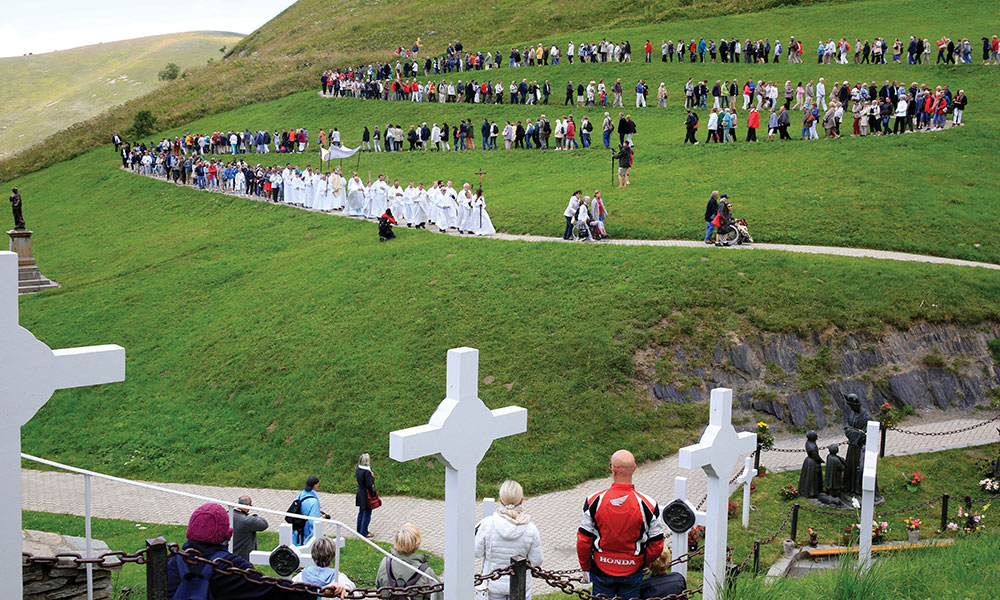
The overarching vision of the document was to present the Church not as an insular, defensive fortress cut off from the modern world, but as a dynamic “pilgrim Church” journeying through history alongside humanity. (48) The Council fashioned Lumen Gentium to call the Church to be an inclusive, missionary community that actively reflects the light of Christ to all nations. This required a move toward an open, relational model – one where the internal unity of believers becomes a living sign of God’s love and a catalyst for global unity, dialogue and deep spiritual renewal.
The key reforms
At the heart of this vision was a profound ecclesiology of communion. Prior to Vatican II, Catholic theology emphasized the Church as a “perfect society” – a self-contained institution governed by canon law that had clear visible boundaries. Lumen Gentium focused instead on the Church as a spiritual “mystery” and a “sacrament or as a sign and instrument both of a very closely knit union with God and of the unity of the whole human race.” (1) It framed the Church as an organic, communal reality.
Lumen Gentium also declared that holiness was not reserved exclusively for priests or religious. The laity had an obligation to strive for sanctity. In the same spirit of Sacrosanctum Concilium, this document moves the laity from passive observers to active participants responsible for sanctifying the secular world.
To support this communal vision, the document introduced structural reforms to the hierarchy, most notably through the principle of episcopal collegiality. While strongly affirming papal primacy, Lumen Gentium clarified that the bishops lead the Church together with the pope, rather than acting merely as his local delegates or administrative agents. (22) The Council established that bishops, by virtue of their sacramental ordination, share in the supreme governance and teaching authority of the global Church, anchoring papal authority within a collaborative, fraternal network.
The Council also restored the permanent diaconate. For centuries, the diaconate had almost always functioned as a temporary, transitional stepping stone on the path to the priesthood. Lumen Gentium restored the office of deacon as a distinct, permanent rank of holy orders. (29)
This reform opened the ordained ministry to both single and married men and allowed deacons to serve as sacramental ministers of charity and liturgy.
Finally, this ecclesial renewal altered Catholic ecumenism. The document noted that the unique Church of Christ “subsists in” the Catholic Church (8), a shift that acknowledges “many elements of sanctification and of truth” exist outside its visible boundaries. (8) This would prompt fresh dialogue with other Christian communities. Lumen Gentium concluded by framing the Blessed Virgin Mary as the ultimate model of the Church, emphasizing her faith and cooperation with grace.
The lasting impact
Ultimately, Lumen Gentium served as the theological engine of Vatican II. Decades after its promulgation, the rise of lay-led ministries, the presence of thousands of deacons globally, and the existence of local, national and international synods of bishops witness to the document’s importance. Through its reforms, it provided the essential framework for modern Catholic identity, governance and global mission.
Pope Leo Catechesis on Lumen Gentium
Pope Leo XIV delivered his catechesis on Lumen Gentium between Feb. 18 and May 13, 2026, as part of his Wednesday Audiences. In his initial offering, he highlighted how the Second Vatican Council used the word “mystery” to describe the Church’s origins. Adopting St. Paul’s use of the term, Pope Leo asserted that the intention was not to say the Church is “something obscure or incomprehensible.” Instead, the Council wanted to point to a reality that was previously hidden, but is now revealed.
According to Pope Leo, St. Paul’s use of the word mystery refers to the manifestation of God’s plan “to unite all creatures thanks to the reconciliatory action of Jesus Christ, an action that was accomplished through his death on the cross.” This plan is experienced first of all in the Church’s celebration of the liturgy. The pontiff explained, “So, there is a certain connection between this mystery and the Church: the Church is the mystery made perceptible.”
Did You Know?
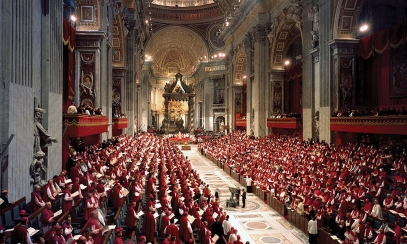
Lumen Gentium was hotly debated at the Second Vatican Council. It also surpassed all other Vatican II documents in terms of revisions. Despite all this, Lumen Gentium passed with 2,151 votes in favor and 5 opposed.
Doug Culp is the chief operating officer for the Pontifical Mission Societies of the United States.