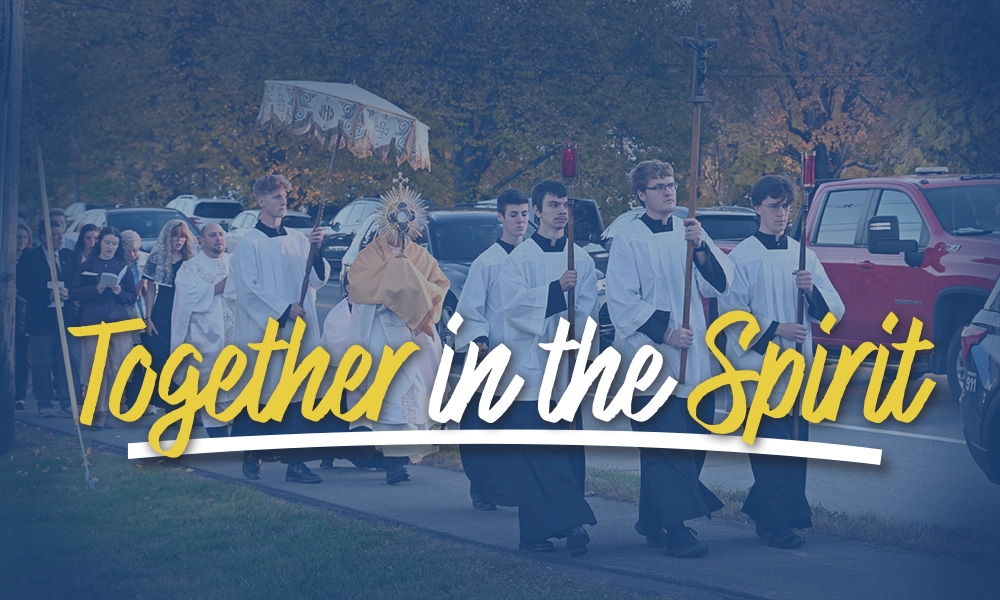
Together in the Spirit
Together in the Spirit, we are called to follow in the footsteps of Christ and to bring His love and mercy to others. Each year, we have an opportunity to do that through the Catholic Appeal, which supports many ministries of our diocese and helps to strengthen and sustain our Church. Those ministries are wide-ranging, touching lives in our churches, our neighborhoods, our hospitals, our schools, and on college campuses. Below are just four examples of how your contributions to the Catholic Appeal are making a difference.
Ministry to Priests
A caring commitment
We all know how important our priests are to the life of the Church, but as they provide spiritual care to us, it is also vital that we ensure they have the care they need. This includes pastoral care, ongoing spiritual formation, educational opportunities, and administrative support.
“With the continued support of the Catholic Appeal, we can ensure that every priest in Maine has what he needs to thrive in his vocation and serve God’s people with renewed birth and joy,” says Father Kyle Doustou, vicar for priests.
Support for priests through the Catholic Appeal takes many forms but includes gatherings such as the annual Priest Institute, guidance through the vicars for priests and senior priests, and leadership training for new pastors and parish administrators, such as a session held last year in Baltimore, Maryland.
“The enriching training experience at Baltimore gave me knowledge and support to equip me to serve the diocese with renewed passion and purpose,” says Father Joseph Lukong, administrator of St. Kateri Tekakwitha Parish in Calais. “Thanks to our bishop for investing in my growth and preparing me for the vital role as an administrator.”
“We learned a lot for our ministry: spiritually, pastorally, and financially,” says Father Brittoraj Amalogam, HGN, administrator of Our Lady of the Lakes Parish in Oquossoc. “I found many things in this training that I was able to take for my ministry here in my parish, and the handout materials and the visual documents help me now for my meetings and the approaches with the volunteers, especially the pastoral council, finance council, and other supportive spiritual groups.”
Vocations
A look to the future
While caring for our current presbyterate is essential, we must also look to the future and provide those discerning vocations with the support they need. Your gifts to the Catholic Appeal sustain the work of formation for seminarians and for men preparing for the permanent diaconate, helping to ensure that our diocese will be served by well-prepared clergy.
The diocese is currently sponsoring or cosponsoring seven seminarians, and there are eight candidates for the permanent diaconate.
Hospital Chaplaincy
A light in a dark time
“It’s a corporal work of mercy to visit the sick, to provide that presence of the Church to people who are in need of that, being that light in a dark time.”
That is how Father Kevin Upham describes his work as a hospital chaplain.
“It’s my hope to bring happiness, the joy of Jesus, the joy of the Christian life and to bring peace to people who are going through difficulties,” he says.
Father Upham has been a full- or part-time hospital chaplain for four years, currently serving at Maine Medical Center (MMC) and Northern Light Mercy Hospital in Portland.
His work at MMC is supported by the annual Catholic Appeal as is the work of priest and lay chaplains at five other secular hospitals in the state.
At MMC, Father Upham serves with two other priests and two lay chaplains. He says he typically visits around 20 patients a day at MMC, but the number has approached 30. They include Catholic consults or referrals and, as time permits, routine visits.
He says the length of each visit depends on the needs of the patient.
“Some people will respectfully say that they are all set, but thank you, so those are short. But sometimes, it takes a few minutes to do the prayers or people want to chat or want to confess,” he says. “A lot of times, the patients are really the ones doing the talking and that’s good. We listen and then we speak when we need to. And of course, the prayers speak for themselves. The Church has very beautiful prayers and those speak volumes.”
Father Upham says you never know how a visit might impact someone’s life.
“The first person I saw today was a consult. She was a practicing Catholic, and she said, ‘Oh, I’m so thankful,’” he says. “Then, you’ve got people who have lapsed, and it’s an opportunity for them to maybe go to confession and to know that there is a place for them, that it’s not too late.”
Father Upham says he finds serving as a chaplain to be fulfilling because it gives him an opportunity to meet people from all walks of life.
“It’s a gift to be able to be present to people in this setting and hopefully to be a positive light for them,” he says.
He says a recent health scare of his own, which resulted in a stay at MMC, gave him a new perspective on the value of a chaplain’s work.
“I was on the other end of the spectrum. I was the patient receiving care, and Father Amandus [Sway] came to see me and anointed me,” he says.
Father Upham says chaplains are often consulted as hospital staff try to best serve patients. They also support staff members and families. They serve as a connection to the sacraments for those who are chronically ill or have long hospital stays. And they are a source of comfort to patients who are dying.
“I remind them of God’s love. And if the family is present, I really want to drive that home, that God loves them and that God’s with them in that moment,” he says. “It’s very intimate. And it’s a special thing to be part of that for people.”
Campus Ministry
An awakening of faith
College is often a turning point for young adults, when many are living independently for the first time. It is a period when the faith of their younger years may be put to the test, or it may be a new opportunity to welcome God into their lives. That is why campus ministry is so important.
“It used to be that Catholic campus ministry supported students that were Catholic so that they continued the practice of their faith in college. This is still true, but now many of the students come having been raised in no faith or not having practiced extensively in their families. Throughout the country and the world, there seems to be a new awakening of young adults to the beauty of the faith. Catholic campus ministry needs to be there to provide answers to questions and opportunities to practice the faith for these people that God is already working through,” says Sister Jacinta Coscia, FSE, campus minister at Bates College in Lewiston. “We need to provide a community on campuses where students can feel free to ask questions and talk about their faith.”
One of those students who had a lot of questions was Sofie Shanbhag, a sophomore at Bates. Sofie hadn’t practiced any faith before her final year of high school when knee surgery limited her mobility and gave her time to think.
“I was forced to slow down and think about different things in my life that I had never really done before,” she says. “There was that kind of first curiosity and then my conversion came from that.”
Sofie arrived at Bates with a desire to continue her journey to the Catholic Church. She participated in the Order of Christian Initiation of Adults at Prince of Peace Parish and at the college.
“I think it was really helpful to already have this group of Catholic students on campus because I knew there was a group that I was able to join and fit into and, also, being able to ask questions from Sister Jacinta, our campus minister. I think she was helpful in answering all the things I was wondering about and in showing me what resources we have on campus,” says Sofie. “It was great to have a greater sense of community, which I definitely felt on campus.”
Students involved in campus ministry say having a Catholic community that they can tap into is vital.
“College is a time when a lot of people can fall away from their faith, so it’s even more important for this aged student to have those resources available,” says Sofie. “I think [without campus ministry] you would lose that sense of belonging that a lot of students get from being part of the group.”
“For me, being able to find that sense of community in the Catholic community was a big part of fostering my faith personally,” says Edwin Cruz-Castillo, a senior at Bowdoin College in Brunswick.
Edwin says he grew up Catholic, but with the help of campus ministry, his faith became his own while at college.
“When you first become independent, a lot of people step into it in a way they haven’t before, and that was definitely the case with me,” he says.
Edwin recalls arriving on campus to find a tight-knit Catholic group of students but one that reached out to welcome freshmen like him.
“They really allowed people in. I started attending these discussion dinners and then, eventually, I started going to Mass regularly,” says Edwin, who is now one of the officers of the Catholic Student Union. “I knew this was a community that I wanted to be a part of, something that I really wanted to lean into, and I found it here on campus.”
As did Mateo Pacelli, a senior at Bowdoin who is also one of the Catholic Student Union officers.
“I came from a very Catholic family, and I knew going into college that I wanted to maintain my faith and whatever practices are affiliated with that,” he says. “Bowdoin is a very secular place, so having that kind of security of my faith to turn to was something I actively sought out.”
Mateo describes college as a “big test period to someone’s faith” and says in his case, pursuing a leadership position in campus ministry helped him solidify his own beliefs.
“When you get confirmed in the religion, you agree to being a soldier of Christ. This is another way of saying, ‘I’m not going to get distracted or dissuaded by this very non-religious area or non-religious place. I’m going to hold myself to a higher standard,’” he says.
While Masses are not regularly held at Bates or Bowdoin, rides are arranged so students can travel together to nearby churches.
“It's kind of intimidating walking into Mass alone, especially when you’re so used to going with your family. And so, opening that door for them is really a big part,” says Edwin.
Weekly adoration is offered on both campuses. There is also Bible study, retreat opportunities, and other gatherings, and at Bowdoin, a Rosary club recently formed.
Father Phil Tracy, the priest liaison to Bowdoin, who previously served as a chaplain at Bates, Bowdoin, and Colby College, says what he has found through his years of experience is that college students are looking to question and willing to learn.
“You can look at a complex thing that they can then wrestle with and be challenged by,” he says. “Because it’s liberal arts, it’s ‘OK, what’s your argument? What are you saying? What does it mean? Oh, the Gospel supersedes political ideology? I’ve heard of that philosopher or someone. Maybe I want to learn more.’”
Father Tracy says while most parishes could not assume the financial burden of campus ministry, it is still important for parishes to forge connections with college students.
“I think for the parish, a lot of parishioners need to know there are young people coming after them,” he says. “And I think, in the rarefied air of academia, it’s valuable to see that there are some people who don’t walk well, that there are some elderly people who have maintained this faith, who have lived their marriage for 60 years in a hook-up culture.”
The Catholic Appeal supports ministry at seven campuses, including the presence of Fellowship of Catholic University Students missionaries at the University of Maine in Orono.
Every Gift Matters
Donations to the Catholic Appeal may be made at https://share.portlanddiocese.org/harvest. Every gift, no matter the size, makes a difference.