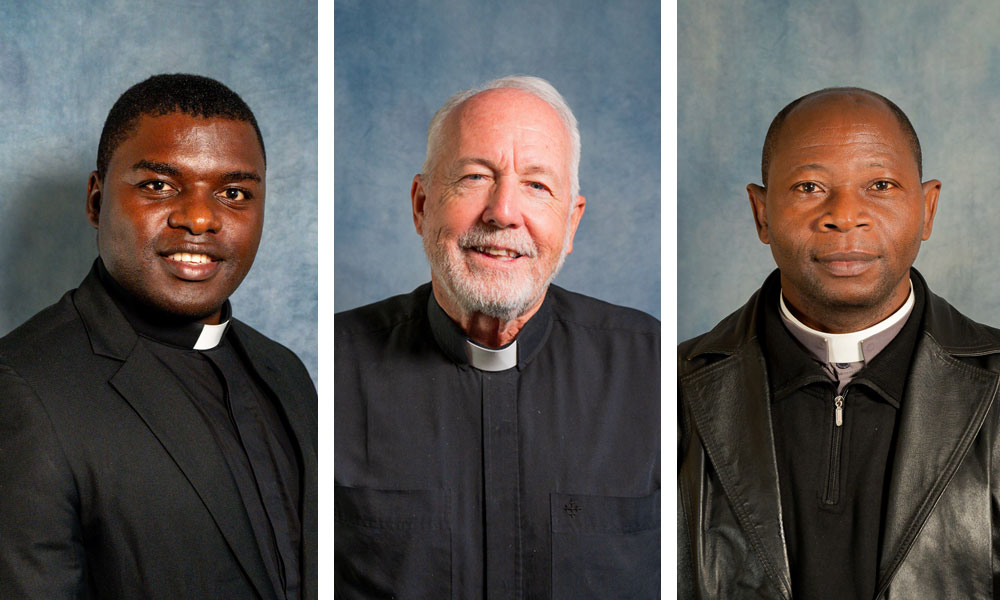
The unfolding gift of the priesthood
“Nothing but you, Lord.”
That is the motto that Father Elvis Ngoran chose when he was ordained a priest for the Diocese of Kumbo in Cameroon in 2020, and he says it explains why he is so happy in his ministry.
“Nothing but you, Lord, nothing but serving your people, doing it for your people. What makes me happy is when I do something for the people … when I listen to confession, when I hear somebody say ‘Father, I would like to go for confession,’ when I baptize, when I celebrate marriages, when I do things for people,” he says.
Father Ngoran is one of three priests recently welcomed to the Diocese of Portland. He is joined by Father Ngange Emmanuel Giantar, also from the Diocese of Kumbo, and by Father Nicholas Harding, a member of the Missionary Oblates of Mary Immaculate. Father Ngoran is currently assigned to St. Brendan the Navigator Parish in Camden, while Father Emmanuel and Father Harding both serve in Hispanic ministry.
This is the latest of many missionary assignments for Father Harding, who says, having moved a lot when he was growing up, it was not difficult adjusting to missionary life.
“There’s a famous teaching of the Church that says grace builds on nature. And so, with my nature, based on all that moving around, it was easy for me to be open to a missionary life,” he says.
For Father Emmanuel, this is his second assignment outside his home country, having previously served in Spain.
“In 2018, I was privileged to go to Spain, where I learned Spanish. I was there for four years. While there, I managed eight parishes, and besides that, I also studied catechesis,” he says.
Father Emmanuel says he was surprised but excited when his bishop, Bishop George Nkuo, told him he would be given a second opportunity to serve abroad.
“I took a deep breath. It was like a dream to me,” he says. “I would like to express my words of gratitude to, first, my bishop, George, for giving me this opportunity, and also for Bishop James [Ruggieri] here for inviting me and for accepting not only me, as a priest, but for my diocese to give this collaboration to share the word of God, to share our faith.”
It is a sentiment echoed by Father Ngoran.
“I was happy because in Kumbo, I already know the diocese. I worked there for six years. And I said, ‘OK, this is a chance to experience another place and to get to know a different culture and how faith is celebrated,’” he says.
Father Elvis Ngoran
Growing up in a rural settlement where priests were not available to regularly celebrate Mass, Father Ngoran credits his parents for raising him and his siblings in the faith. He remembers needing to be attentive during Masses and services because his parents would question him afterwards.
“They would ask me what happened. What did you pray for? What did the catechist say? What did the prayer say?” he recalls.
At age 8, he began playing drums in church, which led to the first spark of his vocation. He says it happened when he played the drums throughout the night during a vigil for a person who had died and then while listening to the priest’s reflection during the funeral Mass.
“He preached and touched on the need to prepare people for the next world, how some people need to prepare others, how it is a collective effort, and that some people have to do a lot of studying to know what it takes to help others,” Father Ngoran recalls. “And I was like, ‘What if I do this? What if I challenge myself, and I’m in this position to study and help others and accompany others?’ That is when it started.”
He says he continued to seek God’s guidance but didn’t tell his parents until after taking his secondary school exams, around the age of 15.
“I told them that I would like to be a priest because from the moment that the Father preached, I prayed, meditated, and saw that God wanted me to be a priest,” he says.
Despite that conviction, influenced by some of his classmates, he signed up to study economics and mathematics at the university.
“I registered, but I never went,” he says. “Each time I thought about going to university and not becoming a priest, I would feel so bad, so at the end, I said, ‘God doesn’t want me to be feeling bad, and if thinking about this makes me feel bad, it’s a sign that God doesn’t want me to go to the university. And when I think about being a priest, when I go to Mass and I see a priest, I’m happy.’”
His first assignment after ordination was as an assistant priest at a large parish in Nkambe Town, where he also served as a chaplain and bursar at St. Rita Catholic Technical High School. He credits Father Anthony Lawir, now serving as pastor of Our Lady of the Snows Parish in Dexter and St. Agnes Parish in Pittsfield, for mentoring him.
“He opened me up, and he gave me the opportunity to develop, to attain my potential. He did not force me to be like himself or force his ideas on me. He allowed me to be a priest as I wanted to be, and that really helped me,” he says.
He says he put what he learned to good use at his subsequent assignments, which included serving as an assistant priest at St. Theresa Cathedral in Kumbo and then as pastor of St. Pius X Parish in Tatum.
He says when he learned he was coming to Maine, he looked at a map and was pleased to see that it was near the ocean and heavily forested. He says he enjoys driving and hopes to explore the state, and he says he has already developed an affinity for miniature golf.
Father Ngange Emmanuel Giantar
Father Emmanuel says he is looking forward to serving Hispanic Catholics in Maine.
“It’s always my joy to serve the people of God wherever I am sent,” he says.
Father Emmanuel is from the village of Taku in northwestern Cameroon. He says when he was young, he stayed with his grandmother, and that was where he was introduced to the faith.
“All the children in the house went for Mass, and we also prayed a lot at home in the evenings, and each time when you missed a Mass, you had to do some hard work, some punishment, or you were scolded because my grandmother was a fervent Catholic,” he says.
Father Emmanuel says when he was between the ages of 7 and 10, his father brought him to a Catholic priest, wishing for him to live and serve there. While the priest said he was still too young, Father Emmanuel points to that as one of the first steps in his vocational journey.
The second came after primary school, when, not having the money to continue his education, he went to work in a shop.
“Each time I saw this particular priest walk into the mall, I was moved. I felt like becoming one. I was attracted by his white cassock — neat, clean — and also by his accent. He spoke good English. That inspired me,” he says.
Despite pressure to work on the Sabbath, he says he insisted on going to church, where he joined the Cadets of Mary.
“In that group, we had a lady who was an ex-Franciscan sister. She was in charge, and she taught us a lot of things in relation to the life of Our Lady,” he says. “Those inspired me. And eventually, I told my dad I wanted to become a priest.”
Even though his father had once tried to arrange for him to live with a priest, he now wanted his son to follow in his footsteps and become a carpenter. Father Emmanuel says he tried it for a year, but the pull of the priesthood was too strong.
“I said, ‘Look, Dad. I must go.’ He didn’t argue, but he told me simply, ‘I don’t have the money to give you to continue your education.’”
Father Emmanuel says when he told a Mill Hill missionary priest at his parish about his lack of finances, the priest simply said, ‘We will see about it.’ The priest then paid the necessary minor seminary fees.
Ordained in 2011, Father Emmanuel served at parishes in Ako and Nkambe Town, as a chaplain at St. Rita Catholic Technical High School, and as a teacher and formator at St. Aloysius Minor Seminary, before being assigned to Spain.
Although he took Spanish lessons, he says he learned a lot through interacting with the people.
“One-on-one contact was a great help,” he says. “The funniest thing is that when I arrived in Spain, when they said anything, I would just say ‘Sí, sí, sí,’ which was the only word I understood.”
After four years, he returned to Kumbo to serve as principal of St. Rita’s. He says having a local priest leading the school helped to drive up attendance to more than 400 children.
“Perhaps they thought, ‘He knows us. He knows our children better. He’s going to take care of them,’” he says.
Father Emmanuel says he was surprised but grateful when Bishop Nkuo told him that he would be going to Maine.
“I am ready to do my best for the honor and glory of God,” he says. “At the end of the day, it’s happiness. I’m happy being a priest. I don’t regret it even for one moment.”
Father Nicholas Harding, OMI
While Father Emmanuel will serve the Hispanic community in southern Maine parishes, Father Harding will be based in Brewer and serve Spanish-speaking Catholics in central and Down East Maine.
He learned Spanish while living in Argentina for three years, where his father had gone for work.
Raised in a Catholic family, Father Harding says he first felt a call to the priesthood around age 8, and it returned when he attended the University of Massachusetts in Amherst.
“They handed out for free a Good News New Testament,” he says. “That prompted my brother to start reading it — we were living in an apartment together — so I started doing it.”
Blaming a desire to follow his will instead of God’s, he didn’t yet pursue his vocation. Instead, he went on to receive a master’s degree in public health from Harvard University in Boston, Massachusetts, and then a law degree from Suffolk University Law School, also in Boston. It led to a career as a legal services attorney working in Nebraska and then Kentucky.
While in Kentucky, he says he spent time at the Abbey of Our Lady of Gethsemani, and that was a turning point.
“That silence and solitude more than anything helped me to finally accept the invitation,” he says. “With the help of a good spiritual director and with prayer, I entered the Missionary Oblates of Mary Immaculate in San Antonio, Texas.”
He was familiar with the Oblates because they ran the parish he attended when living in Nebraska.
“Sometimes people ask you, ‘Why did you choose to become a priest with the Missionary Oblates of Mary Immaculate?’ I didn’t choose it. I felt I accepted it as a response. It wasn’t me coming up with the idea that I will no longer be a lawyer and I would rather be a priest,” he says. “I’m a big follower of St. Ignatius of Loyola. I studied in Rome at the Gregorian University, which is run by the Jesuits, and in his 30-day Ignatian Exercises, St. Ignatius makes the point that one should seek what he calls holy indifference, to be open, like the Virgin Mary: ‘Lord, show me who you want me to be.’”
Ordained in 1992, much of his priestly ministry has been in Spanish-speaking parishes or countries. He describes his years as a priest as an adventure.
“It’s something that continues to unfold as a gift,” he says. “I give thanks to God for the gift of calling me to religious life and the priesthood. It’s something that one continues to enter into and to experience the depths of the graces that come with that vocation. It’s not as though I know what it’s all about and I’m living it fully. It’s a lifelong journey.”
One that has taken him both to big cities and rural villages. His first assignment was in Houston, Texas, in a parish with more than 4,000 registered families.
From there, he was assigned to a parish in Tijuana, Mexico, which included 15 chapels, along with a clinic and a school for children with special needs.
“On average, we had about 600 confirmations each year and close to 1,000 first Communions,” he says. “That was quite a challenge. It was beautiful but very demanding, but we had a team. I was with a religious brother and four other Oblate priests.”
He says the challenging experience taught him two things: the importance of remembering that the Lord is in charge of His Church and the importance of having good formation for laypeople so that they can share in the responsibilities. He says the parish had 150 lay catechists.
After Mexico, Father Harding served at Christ the King Parish in the Ica region of Peru.
“That parish had three parts. The first part was more urban, with 15 chapels and probably about 70,000 people. Then, there was another section that was being developed. So, there were no paved roads, no running water, no electricity, and thousands of shacks, and that region included a prison,” he says. “Then the big part of the parish was in the mountains, and that was another 80 chapels, of which one of them, just to get there on a winding dirt road took over 10 hours.”
Father Harding served there with another Oblate priest and a religious brother, but he says the territory was so large that their aim was to visit each chapel on its patronal feast day and to otherwise rely on lay catechists.
After Peru, Father Harding was sent to Cuba. He says although the population in Habana del Este where he served was around 300,000, very few attended Mass, the result of Communist rule.
“It was very restricted on what you could do for evangelization. They knew everything that we were doing,” he says.
He recalls it being a contemplative experience, including the time spent in lines for things like gas.
“It was two or three hours to fill your tank,” he says.
After brief assignments in Brownsville, Texas, and in Ghana, Father Harding was assigned to Maine, marking the return of the Oblates of Mary Immaculate to the Diocese of Portland. The order has a long history of service in the diocese but has been absent since Fathers Miles and Roger Cyr departed in 2015.