The Mass: “The peace of the Lord be with you always.”
During the Mass, after having prayed the Our Father together, we begin the immediate preparation for the distribution and reception of holy Communion. That preparation by the priest and by the faithful involves several prayers and gestures that often can be overlooked.
The priest begins by praying, “Lord Jesus Christ, who said to your Apostles.” This prayer for peace has been in use since the ninth century and is addressed directly to Jesus, now substantially present on the altar under the appearances of bread and wine. This is unusual, since the prayers at Mass are generally addressed to God the Father. However, like the Memorial Acclamation, which is also addressed to Jesus, this prayer for peace testifies to the Church’s faith that Jesus is present to us in person now through the consecrated elements.
The prayer for peace quotes the words of Jesus to the apostles at the Last Supper, “Peace I leave with you; my peace I give to you” (Jn 14:27). Having quoted the words of Jesus at the Last Supper in the Eucharistic Prayer, “Take this all of you…,” it is not surprising that the celebrant quotes Jesus again from this same Gospel event. The celebrant prays for the peace and unity of the Church. The Eucharist is the sacrament of unity. The reception of holy Communion is meant to express and strengthen the unity of all the members of the Church in faith, hope, and charity.
Then the priest says the same words that Jesus spoke to the apostles when He first appeared to them on the evening of Easter, “Peace be with you” (Jn 20:19). The celebration of the Eucharist is both the memorial of His saving death on the cross, which He announced at the Last Supper, and of His life-giving resurrection. The priest then invites us to offer each other a sign of peace. This gesture, often trivialized to a handshake of greeting, is meant to signify that we are free from all divisions among ourselves and ready to approach the Lord’s Banquet in peace with each other. There is a deeper meaning here that should cause all of us to examine our consciences to make sure we are reconciled with all those who have harmed us. Our reception of holy Communion is meant to signify forgiveness, unity, and peace.
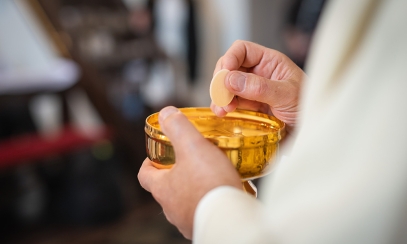
Following the exchange of the sign of peace are a series of gestures associated with breaking the host and mingling a portion of it with the Precious Blood in the chalice. This part of Mass is called the fraction and the co-mingling. While we sing the refrain, “Lamb of God,” the priest breaks the host first in two and then breaks a fragment off one half of the host. While we continue singing, he drops that fragment of the body of the Lord into the Precious Blood saying silently to himself, “May this mingling of the Body and Blood of our Lord Jesus Christ bring eternal life to us who receive it.” The chant Agnus Dei (Lamb of God) originated in Syria to accompany the breaking of the single large eucharistic bread into pieces that could be distributed to the faithful in holy Communion. This particular chant was introduced into the Roman liturgy by Pope Sergius (d. 701), who was Syrian in origin. The Agnus Dei always ends with the petition, “Grant us peace,” consistent with what we and the priest have been praying for during this part of Mass.
From the earliest times, the Eucharist has been known among Christians as the breaking of the bread (Lk 24:35, Acts 2:46, Acts 20:7, 1 Cor 10:17). All the regional versions of the celebration of Mass throughout the Christian world have retained this gesture down to today. Likewise, the mingling of a fragment of the body of the Lord in the blood of the Lord has also been retained across time and across various Christian cultures. The separate consecrations of the bread become the body of the Lord and of the wine become the blood of the Lord signify the Passion and death of Christ, the dividing of His Precious Blood from His body on the cross. In like manner, the mingling of the particle of the Lord’s eucharistic body with the Precious Blood signifies the reunion of body and blood in His life-giving resurrection. Jesus, who once was dead, now lives forever, never to die again. The Lord we receive in holy Communion is the living Lord of life, the conqueror of death who came to reconcile us to the Father and thus to bring peace to us who have been estranged from one another by sin.
The Communion rite continues with the invitation to Communion, the actual reception of holy Communion, and the post-Communion prayer, which draws that part of Mass to a close.
MSGR. MARC B. CARON is director of the Center for Continuing Formation at Saint Mary’s Seminary and University in Baltimore, Maryland.