Five years that shape a lifetime
Five-year-old Solomon has just arrived at the St. Louis Child Development Center in Biddeford on a Monday morning, and he is already busy drawing a picture depicting how he spent his weekend.
Solomon, or Sully, as he is known, is one of 90 children, ages six months to 10 years, served by the center, which is one of Catholic Charities Maine’s longest running programs, dating to 1971. Catholic Charities’ other child development center, St. Elizabeth’s, which recently moved from Portland to Cape Elizabeth, has been operating even longer, since 1968. Both have aged well, receiving five stars, the highest rating, from the Maine Department of Health and Human Services (DHHS).
“People, costs, all the factors, it really checks all of the boxes. The best thing is that I have peace of mind while he’s here because I know he’s not going to be forgotten about,” says Joshua Lessard, Sully’s dad, about St. Louis. “The kids are learning stuff here. There is structure. There are activities, arts and crafts, learning your ABCs.”
“People believe kids start learning at five. The reality is just the opposite. It is not that you stop learning at age five, but for fundamental brain development, the key years are birth to five. So, if you don’t give the kids appropriate stimulation in the first five years, then they will be facing an uphill battle for the rest of their lives. The first five years are essential,” says Bill Hager, director of St. Louis. “The value of what we do, if we do it right, is so much greater than anybody understands.”
Lessard knows the difference St. Louis has made for his son. Sully has been going there since he was a year old, and at age 18 months, the center informed Lessard and his wife that Sully was autistic. While Lessard says they were shocked at first, he is now grateful because early intervention has helped Sully thrive.
“Sully has had a number of wonderful teachers, especially Miss Laura’s class. He’s been in there for probably a year and a half or so, and he’s really developed and grown in that setting, which is great because he was behind in everything for a long time,” says Lessard.
Hager says the key is recognizing that every child is unique and then providing each of them with what he or she needs to succeed.
“Not only is every child different, but also the brain changes constantly. A one-year-old brain has different needs than a three-year-old brain. So, we have to individualize what we do in each classroom,” he says.
Hager says 42% of the children served by St. Louis have some type of developmental delay, a number that is high because the expertise and patience of their staff allows them to serve children that other places won’t take.
He describes the work of St. Louis as addressing three bubbles. The first is watching children because both parents must work. The second is early education and preparing children for the rest of their lives. And the third is serving children with special needs.
Hager says the reason St. Louis can address all three while still getting the highest rating from DHHS is because of Catholic Charities Maine. While most childcare centers have two revenue streams — what parents can pay and what the state contributes — both St. Louis and St. Elizabeth’s also receive invaluable support from Catholic Charities.
“That third-stream money is why we can still be a five while serving these high-risk kids,” says Hager. “It’s a relationship. The higher quality we are, the more tools they have to raise money. The more money they raise, the higher quality we can be.”
“We have a lot of wonderful resources available that smaller programs might not have,” says Candace Parmenter, program director of St. Elizabeth’s. “I think that helps us attract qualified, more experienced staff, which really ties into the quality of the program. I think that we’re more structured in the sense of having a strong curriculum, and having experienced staff means having the knowledge to assess where children are developmentally and to identify if children need extra support.”
Parmenter says it’s the quality of the program and the diversity of the families served that make St. Elizabeth’s stand out.
“It’s our quality coupled with our mission to help everyone. So, we have a balance of families who are high-income, dual-earner working families, down to families who have experienced homelessness or refugees new to this country. It’s very diverse,” she says. “We end up with a kind of natural balance of all of those families.”
She says many of the families they serve value that diversity.
“Maybe their children wouldn’t necessarily be exposed to a community where children speak another language or look a little different from their close-knit family and friends,” she says.
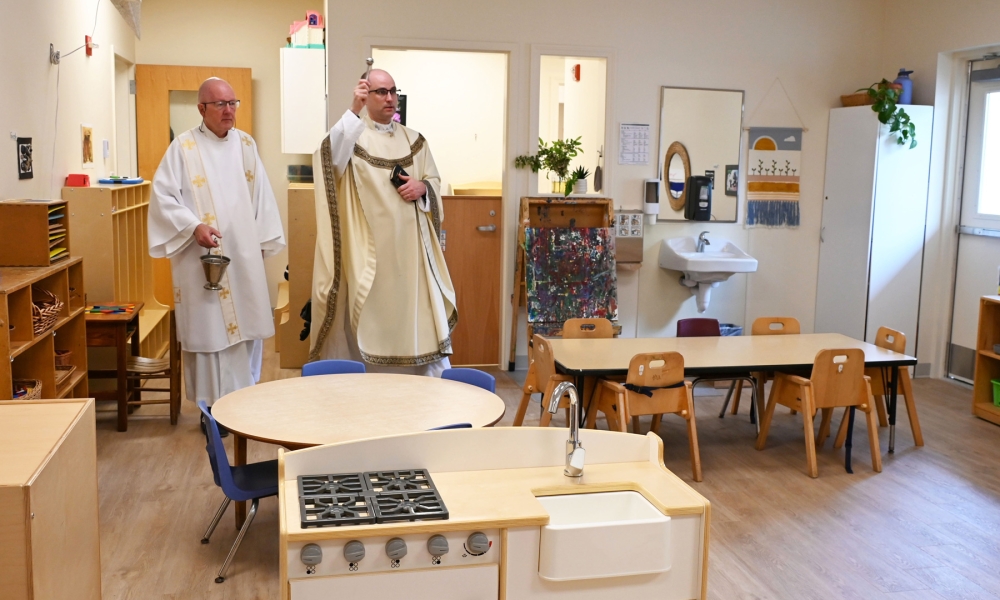
St. Elizabeth’s, which began in the late 19th century as an orphanage run by the Sisters of Mercy, recently celebrated a move from its longtime home in Portland to what had been an unused section of St. Bartholomew Church in Cape Elizabeth. While Parmenter anticipates some changes to the families they serve, she expects to see many of the same smiling faces in the classrooms and playground as she does now. Months before the new site opened, there was already a waiting list, with the greatest demand being for infant care, which St. Elizabeth’s is offering for the first time, thanks to its new location being more modern and single level.
“There is a huge community need for infant and toddler care,” says Parmenter. “The ratios are smaller, so while we can have one teacher for 10 preschoolers, we can only have one teacher with four infants, so the spaces are competitive. There are not as many of them available.”
Both St. Elizabeth’s and St. Louis offer scholarships to help parents who need a hand, for instance, someone who is starting a new job but is still waiting for a state childcare voucher to come through, or perhaps a parent has been laid off but still needs childcare while looking for a new job.
“Not everybody perceives childcare as a charity. Catholic Charities does, and that makes all the difference,” says Hager.
A crucial fundraiser for the child development centers is the Catholic Charities Maine Golf Classic, which raises money for Put Children First scholarships.
The 24th annual tournament will be held on September 21 at The Woodlands Club in Falmouth.
“The scholarships from the golf tournament help us welcome families who might be in a time of transition. We recently had a family who had two working parents. One parent was hospitalized for a length of time, and they weren’t sure how they were going to maintain tuition. The scholarship allowed us to provide consistent care for that child,” says Parmenter. “Both parents are now back to work, but the scholarship allowed their child to remain here without interruption.”
If you would like to support the child development centers by participating in the golf classic, visit www.ccmaine.org/golf.