Recently named monsignors serve with gratitude and trust
“Overwhelmed.” “Humbling.”
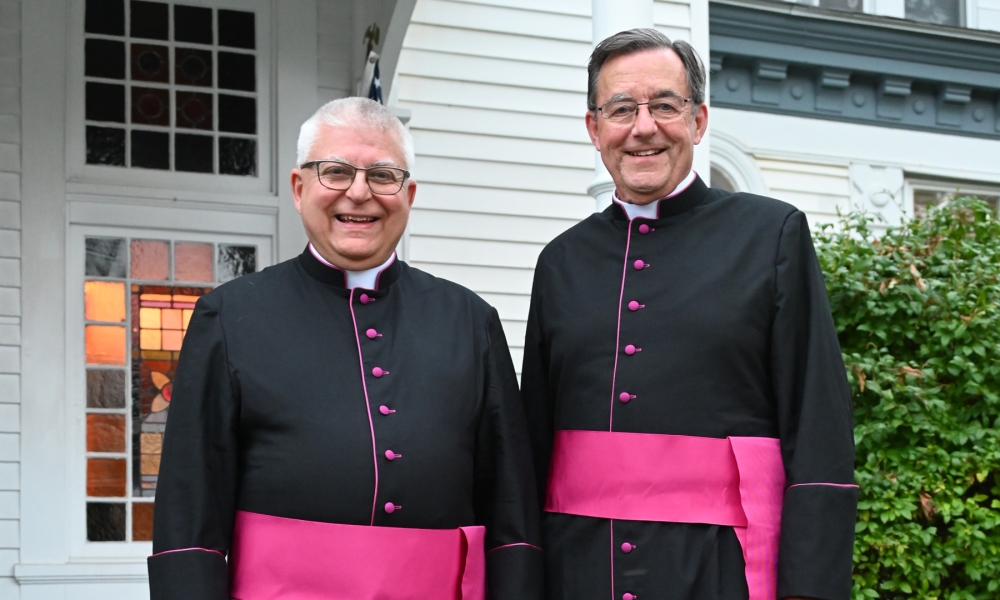
That is how Msgr. Jean-Paul Labrie and Msgr. Frank Murray described their feelings upon learning last year that they had been given the honorary title of monsignor with the rank of chaplain to his holiness.
“It was a complete surprise. It’s still hard for me to think of myself as a monsignor,” says Msgr. Labrie. “I’m touched that the diocese recognized what I do as a parish priest but also what I do with the diocese and with area priests because I’ve also been the vicar forane.”
“As I’ve reflected on it, it’s made me much more aware of how fortunate I have been to have so many people — family members, friends, colleagues, and parishioners — who have responded in so many helpful ways to me as I’ve tried to live out my call to priesthood,” says Msgr. Murray.
The honor was bestowed on the priests by Pope Francis in recognition of their faithful and generous service to the Church. While both Msgr. Labrie and Msgr. Murray say the honor was unexpected, those who know the priests will tell you that it is well deserved.
“They’re both such holy men. Msgr. Labrie has a personality that is so outgoing. Msgr. Murray, no matter when you talk to him, even if it’s on the phone, it’s, ‘Hello, how are you?’ And he sounds like he means it. He’s very sincere. Both of them have sincere hearts,” says Mary Brown, who serves at St. Paul the Apostle Parish in Bangor. “They’re both so special.”
Msgr. Labrie, who will retire from active ministry in July, has served as pastor of St. John Vianney Parish in Fort Kent since 2017, and immediately prior to that, he served as pastor of the Parish of the Precious Blood in Caribou for eight years. He also serves on the Priests’ Personnel Board.
Msgr. Murray retired from active ministry in 2020 but still keeps a busy schedule that includes assisting at Our Lady of the Snows Parish in Dexter and St. Agnes Parish in Pittsfield, celebrating Mass during the summer at Our Lady of the Lake Chapel in Dedham, and serving on the Presbyteral Council, College of Consultors, Diocesan School Board, Northern Light Eastern Maine Medical Center Chaplain Advisory Board, and as chaplain for Pine Cone Council 114 of the Knights of Columbus.
“When people say, ‘You don’t act very retired,’ I tell them that the difference is that now I don’t worry about the next phone call, which, especially in those cluster parishes, it’s a good chance that it would be about a building, or personnel, or budgets,” he says.
Msgr. Labrie and Msgr. Murray both point to their upbringing as being at the root of their vocations, noting that when they were children, the Church was an integral part of family life.
“When we were growing up, when my parents and grandparents were growing up, the Church was where they were accepted, where they could understand the language that was being spoken, where they were provided for socially, educationally, athletically. It was all around the Church,” says Msgr. Murray, who was then an altar server at St. John Church in Bangor.
“I grew up in a Catholic home, in a Catholic community where the Church was the glue that held the community together. It was important. In those days, you didn’t talk about it. You just lived it. You absorbed it,” says Msgr. Labrie, who is originally from Frenchville. “We lived close to the church. We were very involved with the church. My brother and I were altar servers. The school was next to the church, and when there was a funeral during the week, we had permission to go and serve at the funeral.”
Msgr. Labrie says he always knew that as an adult he wanted to work with people and says that early on he felt a need to explore the priesthood. As a result, he chose to attend a college seminary after high school. He says it was in his third year there that he became convinced that the priesthood was his calling.
"There was a moment when I knew interiorly that Jesus would always be with me. That became the door,” he says.
He says his vocation grew out of a friendship with Jesus that developed through prayer and Scripture.
“Jesus has always been a real person in my life. So, it’s a friendship. He’s very dependable. He’s guided me,” says Msgr. Labrie. “He’s not always given me what I want, but I do trust Him.”
And he says, for him, Jesus and the Church are inseparable.
“The Church is a gift that Jesus has given us, so it is part of my relationship with Jesus,” he says. “The body of Christ is the Church. You and I are part of the body of Christ. He’s the head. His presence is real, and the sacramental life is an absolute necessity when it comes to living our faith.”
Msgr. Labrie was ordained a priest at St. Luce Church in Frenchville in 1982. He was 28 years old at the time, which was Msgr. Murray’s age when he entered seminary. Msgr. Murray says although he had thought about the priesthood from time to time in high school, it was something he didn’t immediately pursue.
“I had to really do it inch by inch,” he says.
While still a student at the University of Maine in Orono, he ran for the state legislature and won, becoming the youngest state representative at the time.
After two terms, he ran for the state senate and then secretary of state but lost, the latter by just one vote. Already working part-time at John Bapst High School in Bangor, his alma mater, he became a full-time teacher and track coach there.
Soon, however, Msgr. Murray says he came to realize that he was looking for something more.
“It was gradually coming to the realization that I wanted more from public service. I wanted more than teaching, even though the priesthood requires a lot of public service and requires a lot of teaching,” he says. “It’s a different type of relationship with people.”
He and Msgr. Labrie both say one of the greatest gifts of the priesthood is that it’s an invitation into people’s lives.
“There is an opportunity as a priest to become quickly involved in the very intimate parts of people’s lives. There is a level of trust and a level of openness that I don’t think other professions really have. That is something that I’m amazed about to this very day,” says Msgr. Labrie.
“In the priesthood, you are working for people, hopefully in their best interest, but you really do get to know them, and you get to know them very well,” says Msgr. Murray. “Sometimes you came in at high points in their life and got to know people through their joys and successes, and at other times, you came into their life when it was falling apart or ending or whatever, and yet, you still got to really know them.”
Although he describes himself as an introvert, Msgr. Murray says he learned the importance of engaging with people, whether through words or just a smile.
“I try to make sure I’m conscious of not letting people just walk by,” he says.
He says he lets the Lord guide his words and actions, as well as trying to be cognizant of the reaction he is getting.
“We don’t live in the world by ourselves, so it’s important that we discern others’ responses to efforts that you’re trying to make,” Msgr. Murray says.
“You have to listen to people,” agrees Msgr. Labrie. “And when you make plans, you make them together. And as best as you can, you try to hold yourself accountable.”
“Parishioners and priests are very much alike in the sense that we’re all called to be conduits of God’s grace in the world around us,” says Msgr. Murray.
Among the ways priests bring God’s grace to people is through the sacrament of the anointing of the sick, something Msgr. Labrie says has been an inspiration to him. He recalls one particularly significant moment when he anointed a woman in Caribou.
“I had probably seen her on a regular basis for seven years, and she did not communicate. I was asked to go to anoint her in intensive care at the hospital, which I did. Her first name was Mary, and I told her that I was going to keep her in my prayers, and as I turned around, she said, ‘Thank you, Father.’ Those are the only words she ever spoke to me. Those are the moments that you really know that it all comes together,” he says.
Msgr. Labrie and Msgr. Murray say each assignment they have had through the years has been filled with graced moments, along with some challenges.
“All my assignments were very good,” says Msgr Labrie. “I believed that if I’m here, it’s because God wants me to be here. And if God wants me to be here, God is somehow going to provide the people that are necessary so that it can be fruitful. I don’t think God ever sets us up for failure. It’s just not part of how God works in our lives.”
“I think I’ve had pretty varied experiences, starting off with hospital chaplaincy for six years, followed by campus ministry for seven years, followed by a single church parish for nine years, and then the last three assignments were cluster parishes of six churches, seven churches, and then six churches again. They were varied experiences, but I always felt like I was in the right place at the right time,” says Msgr. Murray. “It was tough to leave every one of them, but I didn’t have to be at the new one very long before I realized that this one has got its challenges and its amazing people just like the last one.”
Reflecting on their decades as priests, both Msgr. Murray and Msgr. Labrie see changes in themselves.
"What has changed me is the Eucharist. It’s not the priesthood. It’s the daily dying and rising that you celebrate. That’s the change that’s come about in my life. It’s not a head thing so much. It’s more of a heart thing,” says Msgr. Labrie.
“When you’re young and you’re going into things, you think you want to be this or that or whatever. You have a preconceived idea of what it is all about and what it might require. Then, you discover this calling is requiring a lot more and a lot of different things and, hopefully, at the same time, in that parallel process, you’re discovering more about yourself,” says Msgr. Murray. “I think it has taught me to keep coming to know Frank Murray better and better and what he needs to share with others as he discovers it about himself.”
For those discerning vocations to religious life or the priesthood, Msgr. Murray and Msgr. Labrie share some advice.
“Look carefully at the priests or the women religious or the men religious. Try to look at them and see that (a) they are happy, (b) they’re living an exciting life, and (c) that they are needed badly,” says Msgr. Murray. “I think we really have to encourage young people to see that some of what’s asked of them is difficult, but those difficulties are things that people with self-confidence and a belief that God is helping them, gracing them, can find ways to meet.”
“You have to be willing to listen to the Lord,” says Msgr. Labrie. “And you have to be willing to trust that His fidelity will never be outdone.”