A hopeful tale of two masters’ theses
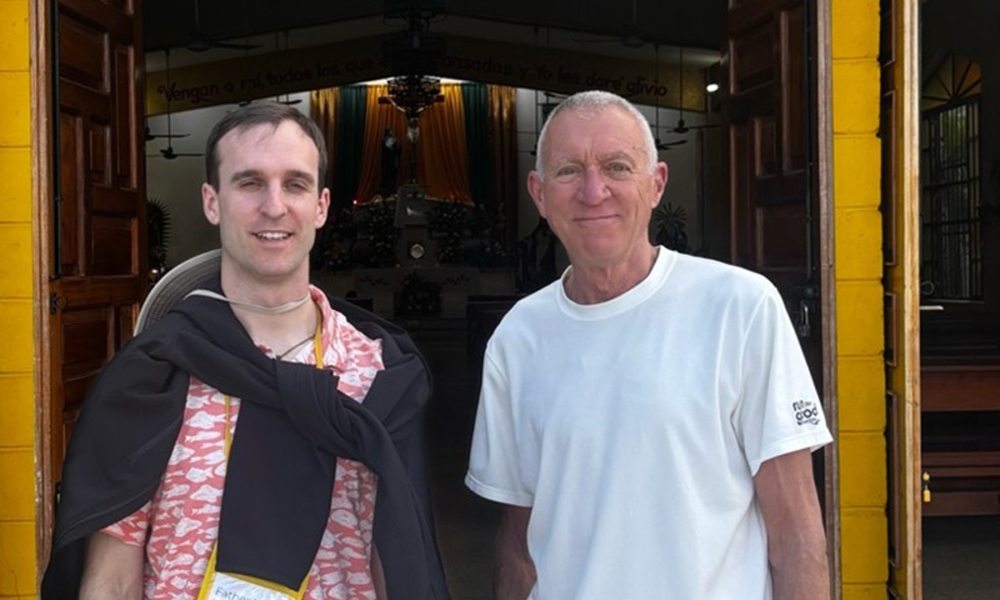
Recently, I had the privilege of being a mentor-reader for Father Matthew Valles’ master’s thesis and then had the opportunity to watch online Father Matthew successfully defend his fine thesis on St. Joseph. Congratulations to Father Matthew Valles, M.A.! The experience made me somewhat nostalgic. I blew off the dust from the faded bound copy of my own 1981 master’s thesis, which was entitled “The Role of the Confessor as Healer: Applying the Appropriate Remedies to the Seven Capital Sins of Contemporary Society,” and leafed through it for the second time since I wrote it 45 years ago. My first thought was, “Wow! How did I ever come up with such a verbose and rambling 19-word title?” If Father Matthew had proposed a 19-word title for his thesis, this reader would have strongly advised him to cut it in half! So, I thought of pride, which is one of the “capital sins” defined by the ancient tradition of the Roman Catholic Church. Then, I noticed how yellowed the pages had become and realized that Father Matthew is considerably less than half my age, and that brought to mind envy, which is another capital sin. By the way, the other five capital sins are anger, gluttony, lust, greed, and sloth. In case you wondered, according to our Catholic tradition, the seven capital sins are called that because these are the sins to which we are most susceptible and are the human tendencies that cause us to commit all the other sins.
Now, after perusing the tome that I wrote while at The Catholic University of America back in my youth, a work that only two people have ever read from cover to cover (that would be me and my professor), I realized that, for the most part, these ancient capital sins, sometimes called the seven “deadly sins,” still continue to plague our contemporary society — except, I thought, for one. Sloth. Not that I advocate sin, of course, but perhaps, I mused to myself, we’d all be a lot better off with a little more sloth these days. After all, if sloth is, as Webster’s Dictionary defines it, laziness and an aversion to work, most of us modern American workaholics, overachievers, and multitaskers, me included, might be much better off and certainly more spiritually balanced with a good dose of sloth to counteract our endless activities and busyness.
But there was perhaps (and here I risk committing the capital sin of pride once again) just one bit of wisdom in my wordy 45-year-old thesis. And surprisingly, I found it in the “Sloth” chapter, of all places. I was reminded that more than the other six capital sins, the working definition of sloth has changed considerably over the centuries. Quoting my own thesis, “in contemporary society, the sin of sloth takes the forms of dejection, boredom, and apathy.” A little more research revealed that, originally, sloth was called the sin of sadness or despair. And, given the times in which we live, all these words, I think, are apt descriptions for our lives today: despair, sadness, dejection, boredom, apathy. That’s sloth today: a loss of hope. Sloth is giving up on God’s gift of life. It’s throwing in the towel, turning away from others, and turning in on self. Sure, we keep busy at work and other active pursuits. We are “productive” beings. But does all this whirling and twirling prevent us from giving hopeful and life-giving attention to what really matters: family, caring for others, being a part of a community of faith, inner peace, our relationship with God?
So, maybe sloth is a serious contemporary social disease that we really do need to battle. And the remedy for the sin of sloth is the virtue of hope, just as the virtue of love is the remedy for the sin of anger. We so desperately need to be people of hope. We need to be beacons of hope to one another to overcome the dejection and apathy that infect our modern world, for as Martin Luther said, “Everything that is done in the world is done by hope.” And the place to find that hope is not in endless activity or in working harder or longer, but in communion with others and in the silence of our hearts. Hope is often found in the most unexpected places and people. This past week, I even managed to find a little bit of hope in an old, yellowed thesis that had been sitting neglected on my shelf for the last 45 years and in a sparkling new thesis on St. Joseph by Father Matthew Valles, M.A., Theology.
Father Louis Phillips is pastor of St. Anthony of Padua Parish in Westbrook