The Mass: “Lord, I am not worthy that you should enter under my roof.”
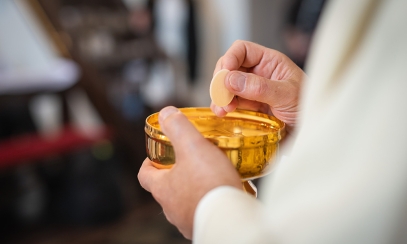
Now we come to the reception of holy Communion itself, the most perfect form of participation for all of us at Mass. Ideally, we receive the body and blood of the Lord from the elements of bread and wine consecrated at that same Mass where we joined the priest in offering our prayers of thanksgiving and intercession to God. Having prayed silently to Jesus, the Lamb of God present on the altar before him, the priest stands before us holding the body of the Lord out to us saying, “Behold the Lamb of God, behold Him who takes away the sins of the world. Blessed are those called to the supper of the Lamb.” Throughout the centuries, some kind of invitation to Communion like this has been consistent in the celebrations of Mass either in the East or the West. This showing of the body of Christ to us is the origin of the two other similar gestures at Mass: the showing of the host after the words of consecration over the bread and the showing of the chalice after the words of consecration over the wine. Those two showings of both consecrated elements were introduced into the Mass in the Middle Ages. They were inspired by the showing of the consecrated elements to the faithful just prior to the reception of holy Communion. The faithful adopt the same posture, kneeling, for the three showings of the body and blood of the Lord, after each consecration and just before the procession to Communion.
The words of the priest and our response to this gesture are inspired by several different scriptural texts. According to St. John’s Gospel (Jn 1:29), when John the Baptist sees Jesus approaching the River Jordan to be baptized, he says to the crowd, “Behold the Lamb of God who takes away the sins of the world.” Likewise, in the Book of Revelation, St. John the Evangelist exclaims, “Blessed are those called to the wedding feast of the Lamb” (Rev 19:9). When we are at Mass, we are participating even now in a foretaste of the eternal banquet in heaven, where the Lamb once slain now lives forever. We respond to the priest’s invitation to Communion with the same words used by the Roman centurion who asked Jesus to come to his house and cure his servant, “Lord I am not worthy that you should enter under my roof” (Lk 7:6-7). In this case, I am the one asking Jesus to enter not my home but my heart in order to heal my soul from sin. Mass then continues with the distribution of holy Communion.
As each person approaches the body or blood of the Lord to receive Communion, he or she bows slightly as a sign of reverence to the Lord who comes to them. Then, there is a fourth and final showing of the body of the Lord or blood of the Lord to each person who receives Communion. The priest, deacon, or extraordinary minister holds the body or blood of the Lord before the person receiving Communion and says, “The Body of Christ” or “The Blood of Christ.” The communicant responds, “Amen,” meaning “I believe,” affirming his or her faith in the One about to be received in Communion.
After receiving Communion, people kneel or sometimes sit to continue their prayer with the Lord. In some countries, people consistently stand to pray after receiving Communion. No specific posture is indicated in the rubrics of the Mass. During the time of Communion, we sing together a psalm or other song to accompany our procession forward to receive Communion. The refrain appointed for this song in the Roman Missal is usually taken from the Gospel reading of that day or an appropriate psalm. A period of silence to deepen our prayer follows the conclusion of the distribution of Communion. Then at times, we may sing another song together, giving thanks to God for the gift of the Eucharist and the blessings that come to us from receiving Communion. Finally, we all stand and the priest offers the prayer after Communion, which brings this portion of Mass to a conclusion. Usually, this prayer refers in some way to our reception of Communion and the increase of faith, hope, and love in our lives that receiving Communion is meant to bring about.
From the point of view of the participation of each person at Mass, the reception of Communion is the high point of the celebration. After this climax, Mass ends without delay. The elements of the concluding rites of Mass will be the subject of our next column.
Msgr. Marc B. Caron is director of the Center for Continuing Formation at St. Mary’s Seminary and University in Baltimore, Maryland.